The first question almost every client asks is "how long until the court can be used?" The honest answer depends on three things: the ground, the weather and how quickly specifications get decided. The figures in this article are working schedules for one turnkey contract — civil works, steel, glass, turf and lighting handled by one team — not promised dates. We lock the final dates after the site survey and once the itemised budget (RAB per component) is approved.
Timeline for one court (indoor or roofed outdoor)
The table below applies to one 10×20 m court with 12 mm tempered glass, synthetic turf with silica sand, LED lighting and a steel roof or canopy — or a court inside an existing building. Some stages overlap, so the total is not a straight sum of the rows.
| Stage | Duration | Notes |
|---|---|---|
| Survey, design, working drawings | 1–2 weeks | Ground check, light orientation, drainage, 3-phase power. |
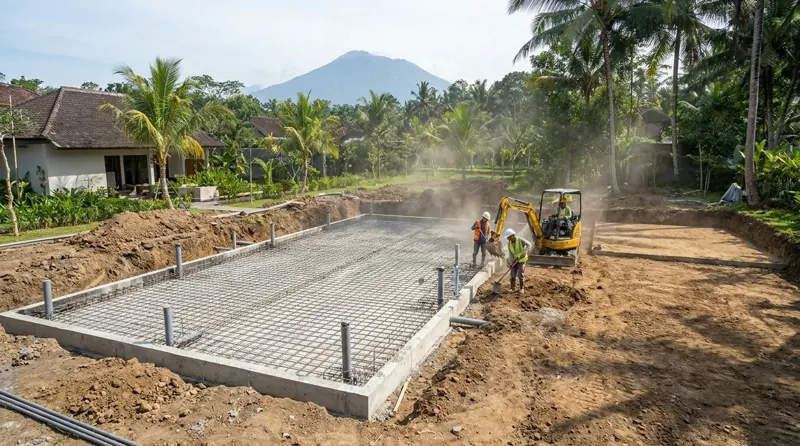
| Earthworks & foundation slab | 2–3 weeks | Compaction, reinforced concrete slab with 0.5% drainage fall. |
| Concrete curing | 3–4 weeks | Cannot be rushed; turf laid on green concrete ripples later. |
| Steel structure & 12 mm tempered glass | 2–3 weeks | Imported glass panels need 4–8 weeks lead time — ordered at design stage. |
| Synthetic turf, silica sand, lines | 1 week | Sand infilled in stages to keep it level. |
| LED lighting, roof, nets, finishing | 1–2 weeks | Lux test 300–500 for commercial courts. |
Total: 10–14 weeks for a single court, 14–18 weeks for a 3–4 court club with a lobby. Medan's rainy season (October–January) adds 2–3 weeks to earthworks and curing.
Two stages drive almost the whole schedule. Concrete curing cannot be shortened safely: turf laid on a slab that has not dried out will ripple within months. Tempered glass is usually imported through Belawan port with a 4–8 week lead time, so it has to be ordered during design week — not after the slab is poured. Get these two right from the start and the other stages rarely cause trouble.
Want a stage-by-stage schedule for your site?
Send the number of courts, the location and whether you want indoor or outdoor. We reply with the stage sequence, the date the glass must be ordered and a site-survey slot.
Get a schedule on WhatsAppSchedule for a 3–4 Court Club + Lobby
A club is not built one court at a time from scratch. All court slabs are poured in one sequence, the steel and glass crew moves from court to court, and the lobby — reception, changing rooms, toilets, waiting area — goes up in parallel. That is why four courts do not take four times as long: the total is 14–18 weeks.
| Week | Work | Notes |
|---|---|---|
| 1–3 | Site survey, zoning layout, lobby design, working drawings, itemised budget | Glass for all courts ordered; PBG technical documents and PLN power upgrade submitted. |
| 3–6 | Earthworks, compaction, drainage pipes, slabs for all courts, lobby foundation | Courts poured in turn, so the first slab starts curing earlier. |
| 6–10 | Concrete curing | In parallel: steel roof/canopy frame and lobby structure. |
| 9–13 | Court steel structure + 12 mm tempered glass | One court finished, the crew moves to the next. |
| 12–15 | Synthetic turf, silica sand, lines | In parallel: lobby electrics, plumbing, changing rooms and toilets. |
| 14–18 | LED lighting + 300–500 lux test, nets, lobby finishing, ball-bounce test, handover | Operations training before opening. |
If a recovery zone (sauna, ice bath) is part of the build, we schedule its mechanical and plumbing work together with the lobby from week one; the extra time is calculated in the budget, based on the specification. What owners often miss: the courts can be ready first, but a club cannot open without toilets and changing rooms. Lobby design decisions matter as much as the glass order.
Where access and the work area can be separated safely, courts 1–2 can open early while the remaining courts are still being finished — rental income starts before the whole club is complete.
Indoor vs Covered Outdoor: Time Difference
The time gap between indoor and covered outdoor is smaller than most people expect. The roof frame goes up while the concrete cures, so a steel canopy adds almost no weeks. What really adds time is a new building: columns, long-span steel, walls and gutters.
| Option (1 court) | Estimated total | What decides it |
|---|---|---|
| Open outdoor, no roof | 8–13 weeks | No roof work. Around 8 weeks is realistic with glass in stock and firm ground. Most exposed to rain while the turf goes down. |
| Covered outdoor (steel canopy) | 10–14 weeks | Roof goes up during curing; minimum free height 6 m, 7–8 m recommended. Once the roof is on, turf and lights go in regardless of weather. |
| Indoor in an existing building (warehouse, hall) | 10–14 weeks | Less earthwork, but the old floor is usually broken out or overlaid with a new slab — curing still takes 3–4 weeks. Free height and structural capacity are checked first. |
| New indoor building | 14–18 weeks | The building structure becomes the critical path; plan it like a club schedule. PBG before building, SLF before use. |
In Medan, a covered outdoor court is often the most sensible compromise: it stays playable in the rain, costs less than an enclosed building and still fits the 10–14 week schedule. For the cost side of each option, see the padel court construction cost guide and the ROI calculator (standard, panoramic + pro LED, and indoor/roof types).
PBG & SLF Permits for a Padel Building
Permits are not part of the construction durations above, but they can shift everything. The two documents clients ask about most:
- PBG (Persetujuan Bangunan Gedung, building approval) — the successor to the IMB. Needed before physical work on permanent structures: a padel building, a steel canopy, a lobby. It is filed through the SIMBG system; for sites in Medan city via the Medan city licensing service, in Deli Serdang and Binjai via their own local governments.
- SLF (Sertifikat Laik Fungsi, certificate of fitness for use) — issued after the building is finished and inspected: structure, electrics, fire safety, access and sanitation. For a commercial club open to the public, the SLF is required before the building is used.
The club's business licence (NIB via OSS) is handled separately by the business owner. A private court at home usually needs a PBG when there is a permanent structure, but exact rules differ by area and by housing-estate management.
| When | Document | Effect on the schedule |
|---|---|---|
| Design weeks | Working drawings, steel and foundation calculations, electrical specification, budget | Basis for the PBG application — prepared in parallel with the glass order. |
| Before earthworks | PBG issued | Physical work starts; if it is not issued yet, earthworks and foundations wait. |
| After handover | SLF inspection and issue | Sets the opening date of a commercial club. |
How long the PBG and SLF take depends on document completeness and the local office's queue, so we do not include them in the 10–14 or 14–18 week figures. What we can control: the technical documents are ready in week one, so the application never waits on the contractor. Always confirm current requirements with the local office or a licensing consultant.
Medan Rainy Season (Oct–Jan): What Shifts
It rains in Medan for most of the year, but October–January is the stretch that disrupts site work most: heavy afternoon-to-night downpours, waterlogged ground and short dry windows. The project does not stop — the sequence changes. On average the rainy season adds 2–3 weeks, almost all of it in earthworks and slab drying.
| Work | In the rain | How we protect the schedule |
|---|---|---|
| Earthworks & compaction | Wet soil will not reach target density; drainage trenches fill with water. | Temporary channels and pumps; gravel layer placed early. |
| Slab pour | Rain in the first hours damages the concrete surface. | Morning pours in dry windows, tarpaulins on site. |
| Curing & slab drying | Curing itself is fine (concrete needs moisture), but the slab takes longer to dry before turf. | Roof built first so the slab is covered. |
| Synthetic turf & silica sand | Turf on a damp slab ripples; wet sand clumps. | Laid under the roof; sand stored covered. |
| Steel, glass, roof, lighting | Continue, except during lightning or strong wind. | Scheduled on days when wet work is on hold. |
In practice: if a club must open before the year-end holidays, start earthworks by August at the latest and order glass in July. A project starting in October can still go ahead — add 2–3 weeks to the schedule and build the roof first. The slab fall of 0.5–1% and the underground drainage pipes are covered in the padel court technical standards.
What slows projects down most
- Tempered glass ordered late — the longest item on the critical path.
- 3-phase power not ready when lights are due.
- Court repositioned after the slab is poured.
- Former swamp or fresh fill that has not settled — extra compaction needed.
- PBG documents prepared only after the design is final, so earthworks wait for the permit.
- Lobby design or turf colour changed after materials were ordered.
How to shorten the schedule
- Fix glass, turf and lighting specifications in week one.
- Apply for the PLN capacity upgrade alongside earthworks.
- Build the roof in parallel with concrete curing.
- Use one contractor for civil, steel and court works — vendor coordination is the most common cause of delay.
- Prepare the PBG technical documents together with the working drawings, not after them.
See also the padel court construction cost, the technical standards and the guide to a private padel court at home. To model capex and payback for your number of courts, use the ROI calculator.
What We Need to Draft Your Schedule
We can draft a stage-by-stage schedule before the survey if you send:
- Location: the district in Medan city or the regency (Deli Serdang, Binjai and others).
- Plot size and photos — one court needs about 12×22 m including run-off.
- Number of courts and the option: open outdoor, covered outdoor, indoor in an existing building, or a new building.
- Power status: current PLN capacity, 3-phase or not.
- Target opening date, if you have one.
From this we set the stage sequence and the glass order date. Final figures are fixed after the site survey, together with the itemised budget and progress-based payment terms.
FAQ
Can a padel court be finished in 2 months?
For one outdoor court with glass in stock and firm ground, yes; 10–14 weeks is the safe figure.
Does the rainy season stop the project?
It does not stop it, but earthworks and curing slow by 2–3 weeks; roof and steel can continue.
When should we start to open for the year-end holidays?
Start earthworks by August at the latest and order glass in July. That means survey and design should be finished in July.
How long does a 3–4 court padel club take to build?
About 14–18 weeks including the lobby. All court slabs are poured in one sequence, then steel and glass go in court by court while the lobby is built in parallel. If there is a recovery zone, its mechanical and plumbing work is scheduled when the budget is prepared.
Which is faster, indoor or covered outdoor?
A covered outdoor court and an indoor court in an existing building both take about 10–14 weeks, because the roof goes up in parallel with concrete curing. A new indoor building takes longer, about 14–18 weeks, because the building structure becomes the critical path.
Can construction start before the PBG is issued?
Physical work on permanent structures should start after the PBG is issued. What can run in parallel: survey, design, working drawings, the glass order and the PLN power upgrade application. PBG processing time is not included in the 10–14 week construction figure.
Lock in your padel court build schedule
Send the location, plot size, number of courts and target opening date on WhatsApp. We reply with a stage-by-stage schedule and a site-survey slot in Medan or North Sumatra.
Send project details on WhatsApp