Padel is the fastest-growing racket sport on the planet, and Medan — Indonesia's third-largest city — is right at the start of its wave. New courts fill up faster than they can be built, while supply per capita remains far below Jakarta or Bali. If you are weighing the padel court construction cost in Medan as a business plan, this guide breaks down every real number you need: the build budget, the operating economics of the Medan market, the hidden costs specific to North Sumatra, and an illustrative payback period for a single court versus a full 4-court club.
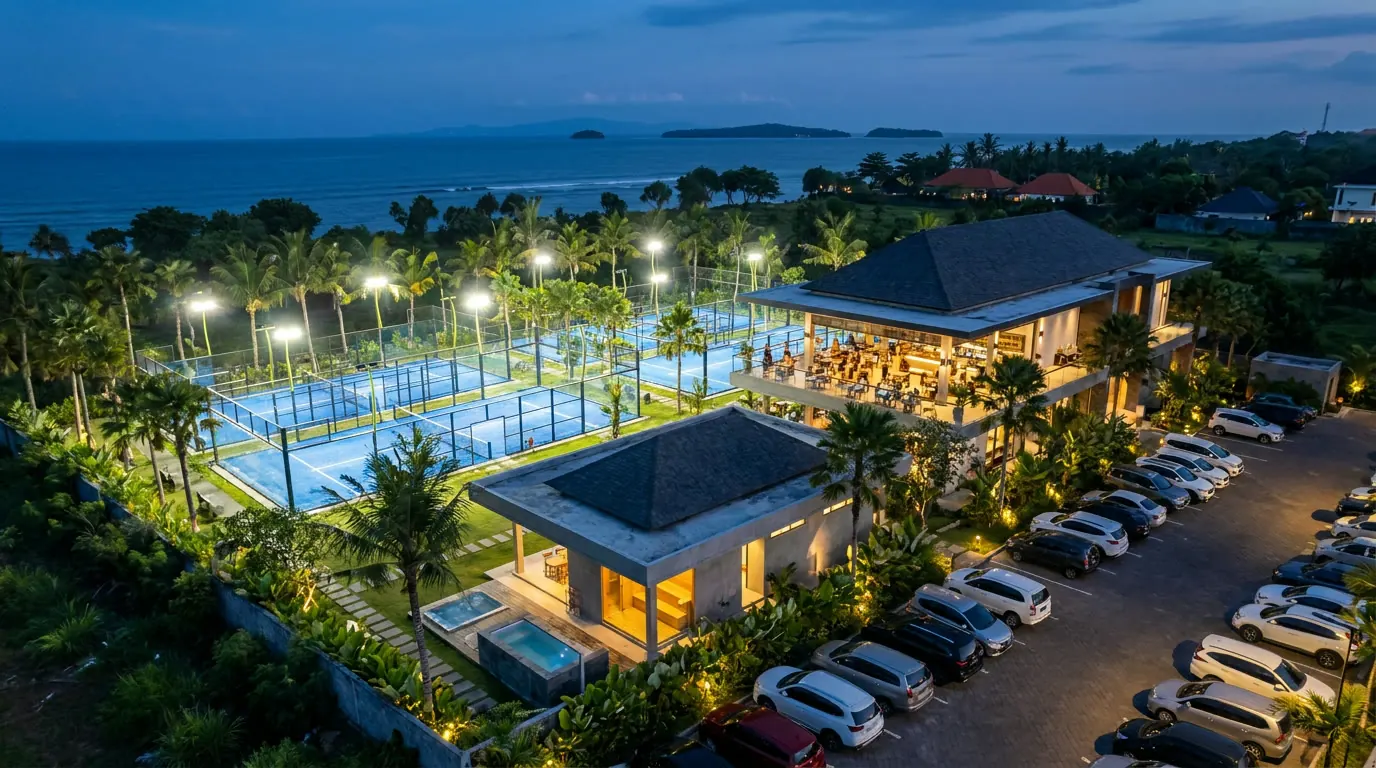
Why padel is booming in Medan and beats classic tennis on ROI
Padel sells differently from tennis, and that is the whole investment thesis. A tennis court is almost always a two-player booking on a large footprint. A padel court is enclosed in glass, plays four players at once, and the social, low-barrier nature of the game means courts get booked in tight back-to-back sessions all evening. The result: more revenue squeezed from a smaller piece of land.
For a padel club investment in Medan, the demand picture in 2026 is exceptional for a different reason than Jakarta: scarcity. The city's business community, young professionals around Polonia and the Ring Road corridor, and university crowds in Medan Baru are discovering the sport faster than courts are being built. Early movers can still "own" an entire district. When you can fill prime-time slots reliably, a padel court generates stronger revenue per square metre and a faster payback than a comparable tennis facility — which is exactly why operators are choosing to build a padel court in Medan now, before the market matures.
Want the exact number for your Medan site?
Send us your location and land size on WhatsApp and we will prepare a tailored cost estimate.
Chat on WhatsAppPadel court construction cost breakdown: single court vs 4-court club
A single FIP-standard court (20m × 10m playing area) in Medan typically lands between Rp 700 million and Rp 1.1 billion, depending on site condition, the grade of imported materials, and how premium your finishing is. The biggest swing factors are the steel-and-glass structure and the surface. Medan has one structural advantage: Belawan port is nearby, which shortens the import chain for glass and steel compared with many other Indonesian cities. The table below shows an illustrative breakdown for a single court alongside a 4-court club with a shared recovery zone.
| Cost component | Single court (IDR) | 4-court club + recovery (IDR) |
|---|---|---|
| Site prep, foundation & concrete | 100M – 160M | 400M – 600M |
| Drainage system (Medan rainfall) | 40M – 70M | 150M – 240M |
| Galvanised steel structure | 180M – 280M | 700M – 1.05B |
| 12mm tempered glass | 130M – 220M | 520M – 880M |
| Playing surface (turf / acrylic) | 90M – 150M | 340M – 580M |
| Match-standard LED lighting | 45M – 80M | 170M – 300M |
| Fencing, net & accessories | 25M – 45M | 90M – 170M |
| Import & logistics via Belawan | 50M – 100M | 200M – 400M |
| Recovery zone (sauna, ice bath, changing rooms) | — | 350M – 600M |
| Café / pro-shop fit-out | — | 200M – 400M |
| Indicative total | Rp 700M – 1.1B | Rp 3.1B – 5.2B |
The headline takeaway: a 4-court club is not four times the price of one court. Shared site preparation, a single drainage network, bulk-imported steel and glass, and one set of back-of-house facilities mean the cost per court drops while the revenue potential multiplies. And in Medan, land and construction labour cost meaningfully less than in Jakarta — one reason the capital structure of a Medan padel project is friendlier to investors.
Get a budget for my site
Send your location, plot size and number of courts. We turn the table above into an itemised budget for your site: slab, drainage, steel, glass, turf, lighting and roof.
Request a budget on WhatsAppMedan operating economics: hourly rate, occupancy and revenue per court
The build is only half the story. What turns a padel court into a business is prime-time occupancy. In Medan, hourly rates currently run roughly Rp 150,000 (off-peak) to Rp 300,000 (prime-time) per court per hour, with prime-time being weekday evenings and weekends.
Here is an illustrative monthly model for one court at a healthy ~70% prime-time occupancy:
| Metric | Illustrative value |
|---|---|
| Blended average rate / hour | Rp 200,000 – 220,000 |
| Filled hours / day / court | 8 – 9 hours |
| Occupancy at prime time | ~70% |
| Estimated revenue / court / month | Rp 50M – 65M |
| Operating margin (after staff, utilities, maintenance) | ~45% – 55% |
A single well-run court in Medan can therefore contribute roughly Rp 25M to 35M of monthly operating profit. In a club, racket and ball rental, café and pro-shop sales, membership, coaching and tournament hosting layer additional revenue on top — which is where the strongest margins come from.
Hidden costs of building a padel court in Medan
Spreadsheet budgets quietly drift over because of factors specific to Medan and North Sumatra. A reliable padel court contractor in Medan prices these in from day one:
- Import logistics via Belawan. Tempered glass, galvanised steel kits and competition turf are largely imported. Belawan's proximity cuts inland freight, but customs duty and port handling can still add 8–15% of material value and weeks to the timeline.
- Medan's rainfall. The city gets heavy rain nearly year-round, with no true dry season. Proper sub-base engineering and a layered drainage network are not optional — skimping here causes ponding, surface failure and lost revenue every single week.
- Humidity corrosion. Tropical humidity — and coastal air for sites toward Belawan and Marelan — attacks untreated steel. Hot-dip galvanising and anti-corrosion hardware protect the asset for a decade instead of years.
- Permits & licensing. PBG building approval through the Medan city administration, electrical compliance and business licensing need to be budgeted in both money and time.
How a recovery zone raises retention and pricing power
The difference between a court and a club is the experience around the game. A Kontraktor Padel Medan complex pairs FIP-standard courts with a recovery zone: a sauna, an ice bath, proper changing rooms and a café. This is not a vanity add-on, it is a margin engine — and in Medan, clubs offering it can still be counted on one hand, so the differentiation is immediate. A recovery zone keeps players on-site longer, justifies a premium membership tier, and dramatically lifts retention, because members come for the whole ritual, not just the match.
Higher retention means more predictable occupancy, and predictable occupancy is what de-risks the entire investment. Operators with recovery and café facilities consistently command higher hourly rates and stronger membership pricing than bare-court venues.
Ready to model your Medan padel club?
We will walk you through a full build budget, ROI projection and timeline for your district of Medan.
Chat on WhatsAppIllustrative payback and return on investment
Putting the pieces together: a 4-court club in a strong Medan location — think the Ring Road lifestyle corridor, Medan Johor or a Deli Serdang township — built at roughly Rp 3.1–5.2 billion all-in including the recovery zone and café, generating Rp 50M–65M revenue per court per month at ~70% prime-time occupancy, can reach an illustrative payback of 24 to 30 months. Lower hourly rates than Jakarta are offset by cheaper land and construction plus thinner competition. Add coaching, tournaments, membership and café revenue, and well-run clubs often beat that.
That payback profile is what makes padel one of the most compelling sport-and-leisure plays in Medan today, especially compared with the slow, two-player economics of a traditional tennis court.
Disclaimer: All figures above are illustrative ranges for planning purposes only and are not a quote. Actual construction cost, revenue and payback depend on your specific site, land size, location, material grade, financing and operating model. Contact us for an accurate, site-specific estimate for Medan.