A padel court looks deceptively simple: a glass-and-mesh box on a flat surface. But the difference between a court that plays like a professional venue and one that warps, floods and corrodes within two seasons lies entirely in the engineering beneath the surface. For any developer, hotel or home owner working with a padel court contractor in Medan, understanding the FIP technical standards is the single best safeguard against an expensive mistake.
This guide walks through the dimensions, glass, surface, and — most critically for Medan — the foundation and drainage that keep a court playable in a city where heavy rain falls nearly year-round. Exact specifications always depend on the design brief and the standard you adopt, but the principles below are non-negotiable.
FIP Padel Court Dimensions & Layout
The International Padel Federation (FIP) defines a rectangular playing area of 10 metres wide by 20 metres long measured on the inside of the enclosure — exactly 200 square metres. A net divides the court into two halves, and each half is split by service lines into service boxes. All lines are 5 cm wide in a colour that contrasts clearly with the surface.
The enclosure itself is part of play. Solid back and side walls (glass or concrete) reach 3 metres high, topped by a metallic mesh that brings the total enclosure height to 4 metres at the ends. Maintaining a clear safety zone above and a minimum free height of 6 metres over the court is essential — anything less and high lobs become unplayable. That free-height figure is also the first thing we check when assessing warehouses around Medan for indoor-court conversion, an increasingly popular option given the city's rain.
Not sure your Medan site fits a full FIP court?
Send us your plot dimensions and we will confirm whether a standard 10×20 m court fits — or recommend the best layout.
Chat on WhatsAppSteel Frame & Tempered Glass
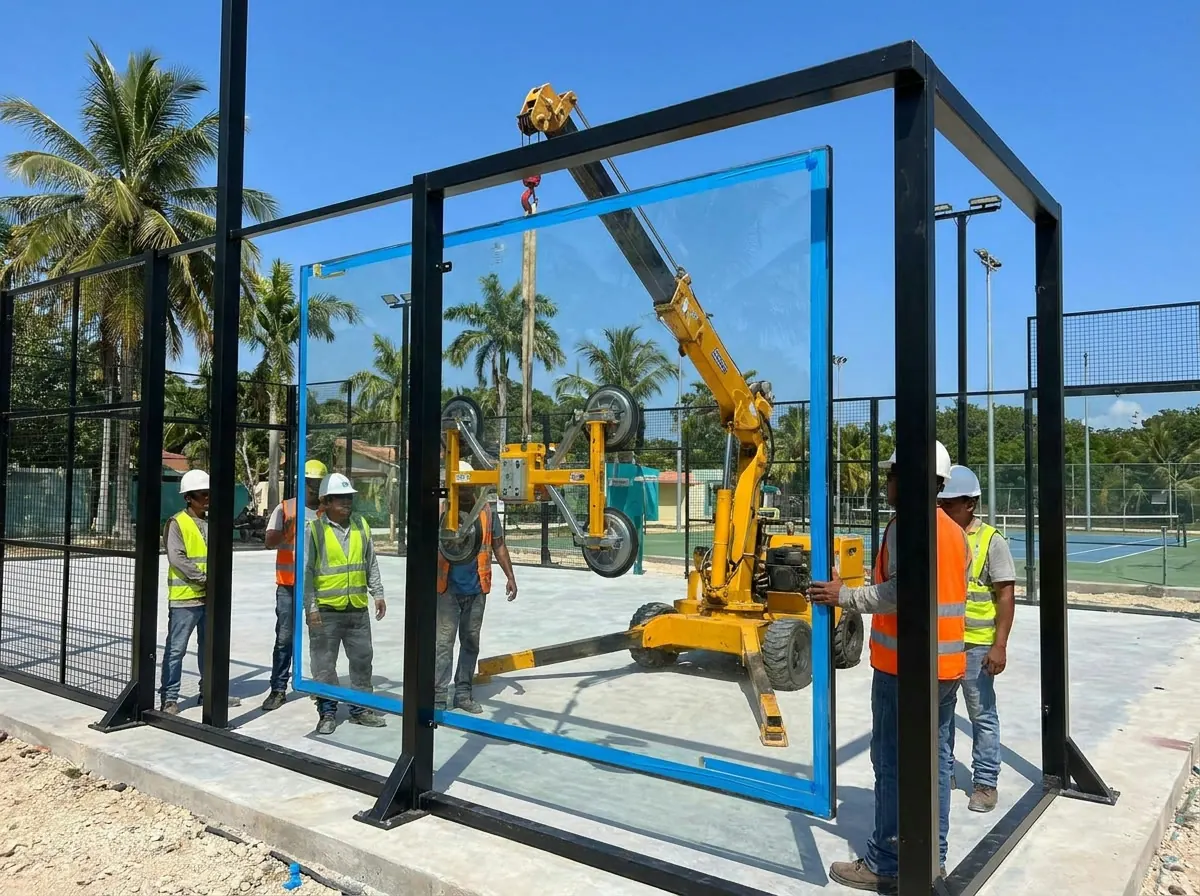
The court structure carries the glass panels and absorbs the constant impact of ball and body against the walls. In Medan, the structural material decision is also a corrosion decision. Year-round tropical humidity — plus coastal air for sites toward Belawan and Marelan — attacks ordinary steel, leaving rust streaks and weakening welds. A professional sports court construction spec for North Sumatra uses hot-dip galvanised steel — and frequently an additional powder-coat finish — to resist that environment for the long term. This is the kind of detail that separates a durable installation from a maintenance headache.
The walls themselves use 10 to 12 mm tempered (toughened) glass. Tempered glass is several times stronger than ordinary glass and, critically, shatters into small blunt fragments rather than dangerous shards if it ever fails. On Medan projects we generally recommend 12 mm for extra safety margin, fixed to the galvanised frame with stainless fittings and rubber gaskets that absorb ball-impact vibration.
Padel Court Surface & Bounce
The playing surface defines how the game feels. Two options dominate:
- Monofilament synthetic turf with silica sand infill — the most common professional choice. The sand stabilises the fibres and produces a consistent, slightly slowed bounce that most players prefer, while offering good grip and joint comfort — a real advantage in Medan's humid conditions.
- Acrylic hard court — a faster, lower-maintenance surface that delivers a true, predictable bounce and suits players who want a quicker game.
Whichever surface you choose, the key requirement is uniformity: the ball must bounce identically across the entire court. That uniformity comes not from the turf itself but from the perfectly level, well-drained base underneath it.
Foundation & Drainage: The Most Critical Layer
If there is one section to read twice, it is this one. The foundation and drainage system is the most critical — and most often underestimated — part of any padel court in Medan, a city that ranks among Indonesia's rainiest. Get it wrong and no amount of premium glass or turf will save the court.
A correctly built base is layered:
- Compacted soil — the subgrade is excavated and mechanically compacted to prevent future settling.
- Sub-surface drainage pipes — perforated pipes channel water away from the court footprint.
- Gravel layer — a graded aggregate bed that lets water percolate down to the pipes.
- Reinforced concrete slab — a steel-reinforced slab poured to a precise slope (typically a gentle 1% gradient) so water runs off rather than pooling.
That precise slope is what makes a court usable in Medan. On a properly engineered base, surface rainwater clears in roughly 10 minutes after a downpour, so players are back on court the same afternoon instead of waiting for a flooded slab to evaporate. In a city where it can rain any month of the year, drainage engineering — not aesthetics — is where an experienced Medan padel court contractor earns their value.
Lighting & Court Orientation
For evening play and amateur or professional competition alike, the court needs glare-free LED lighting delivering 300+ lux evenly across the surface, with fixtures positioned to avoid shadows in the corners and direct glare into players' eyes. Higher tournament levels demand more, but 300 lux is a sound baseline for club play — and in Medan's commercial clubs, evenings are exactly when the courts earn their revenue.
Wherever the plot allows, an outdoor court is oriented on a North–South axis. This keeps the low morning and evening sun out of the players' line of sight, reducing blinding glare during the most popular playing hours — a small planning decision that meaningfully improves the daily experience.
Why Use an Experienced Medan Contractor
Building a court in Medan carries challenges a generic builder rarely anticipates. A specialist padel court contractor in Medan manages three things that routinely derail projects: climate (the drainage and galvanised-steel specs above, plus concrete scheduling around the rainfall pattern), permits (PBG building approval through the Medan city administration must be in order before pouring concrete), and import logistics (tempered glass, structural steel and certified turf are frequently imported — Belawan port nearby is an advantage, but customs timing still affects the whole schedule).
Increasingly, clients also ask us to integrate a recovery zone beside the court — sauna, ice bath, changing rooms — that turns a single court into a small wellness destination and lifts both member retention and revenue. In Medan, where almost no venue offers this yet, it is worth planning into the layout from day one rather than retrofitting later. We focus 100% on Medan and North Sumatra: all 21 city districts, Deli Serdang, Binjai, and the resort areas of Berastagi and Lake Toba.
Technical Spec Sheet
The table below summarises typical FIP-aligned specifications. Treat it as a reference starting point — exact figures depend on the design and the standard adopted for your project.
| Element | Standard Specification |
|---|---|
| Court dimensions | 10 m × 20 m (200 m² playing area) |
| Wall / glass height | 3 m glass + mesh to 4 m total at ends |
| Minimum free height | 6 m clear above the court |
| Glass thickness | 10–12 mm tempered (toughened) glass |
| Structural frame | Hot-dip galvanised, anti-corrosion steel |
| Playing surface | Monofilament synthetic turf + silica infill (or acrylic) |
| Lighting | Glare-free LED, 300+ lux even coverage |
| Court orientation | North–South axis preferred |
| Drainage slope | ~1% precise gradient; clears water in ~10 min |
| Foundation | Compacted soil · drainage pipes · gravel · reinforced concrete |
Specifications on this page are provided for general guidance. Final dimensions, materials and tolerances must follow the specific FIP standard and design brief adopted for each individual project.
Ready for a court engineered for Medan's climate?
Talk to Kontraktor Padel Medan about an FIP-standard build with rain-grade drainage and an optional recovery zone.
Chat on WhatsApp