This guide is for home owners and villa owners in Medan, Deli Serdang, Binjai and the rest of North Sumatra who want a full-size padel court on their own land. We build FIP-standard courts turnkey under one contract — slab and drainage, galvanised steel, tempered glass, turf and lighting — with an itemised budget per component and progress-based payment terms. Every figure below is an estimate; the final number comes after a site survey.
Pembaca Indonesia: Baca versi Bahasa Indonesia.
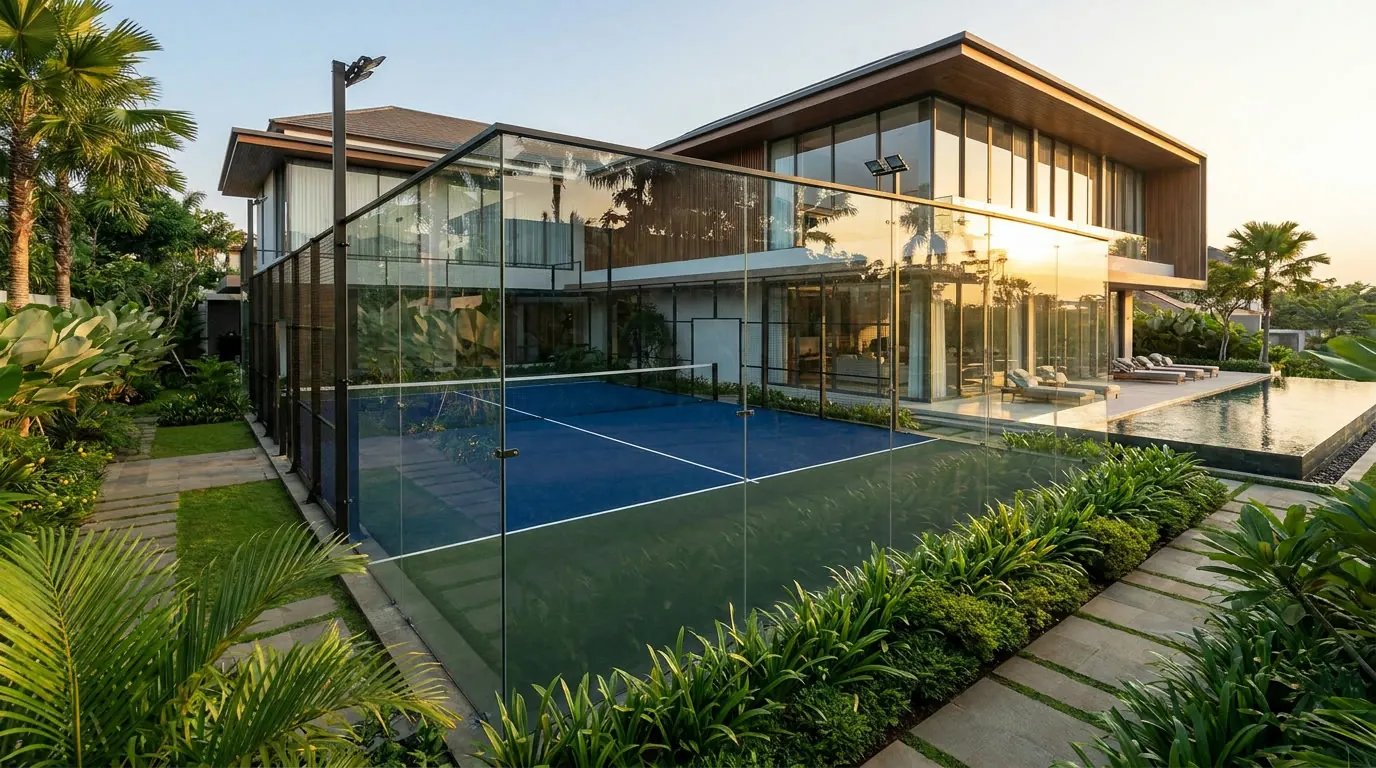
Why Medan Home Owners Build a Private Padel Court
A private court removes the two things club players complain about most: booking and waiting. The family plays at 6 a.m. before work or at 10 p.m. after dinner, and the court doubles as a place to host friends and business partners. For owners who rent out a villa, a padel court is a feature that shows up in the listing and in guests' searches. The trade-off is space and budget — which is why plot size and cost come first in this guide.
Minimum Plot Size for a Private Padel Court (10×20 m + Run-off)
The FIP playing area is fixed at 10 × 20 m (200 m²), measured inside the walls. A court never sits flush against a boundary: you need room for the entrance openings, light posts that stand outside the structure, a perimeter drainage channel and space for the crew to install glass panels. In practice we plan about 12 × 22 m (≈264 m²) of level, usable land per court — the same figure we use for club courts.
Two other dimensions matter. If the court will be roofed, the clear height above the playing surface must be at least 6 m, with 7–8 m recommended so lobs do not hit the roof. Outdoors, a North–South axis keeps the low morning and afternoon sun out of the players' eyes. A site survey also checks soil bearing capacity and where rainwater will go — essential in Medan, where heavy rain can fall in any month.
| Clear, level area on your plot | Court option | What we check |
|---|---|---|
| Less than about 12 × 22 m | A full 10 × 20 m court is usually not practical: no room for light posts, drainage channel and access | Whether the court can be rotated, a wall moved or the garden layout changed to free up space |
| About 12 × 22 m (≈264 m²) | Standard private outdoor court: 10 × 20 m, 10–12 mm tempered glass, synthetic turf + silica sand, LED on posts | North–South orientation, slab fall 0.5–1%, power supply for the lights |
| About 12 × 22 m plus space for roof columns outside the court line | Covered court with a steel canopy | Clear height 6 m minimum (7–8 m recommended), distance to neighbours, PBG permit, where roof water drains |
| About 12 × 22 m plus a terrace or garden strip on one long side | Panoramic court with a viewing side toward the house or pool deck | Slab precision for the glass, steel detailing, sound toward neighbouring houses |
| About 24 × 22 m (two court footprints) | Two courts, for a family compound or a cluster of villas | Shared lighting circuit and drainage; scope closer to a small club |
The table follows the 12 × 22 m planning area we use for every court. The exact layout — and whether a tighter plot can work — is confirmed on site. The full dimension checklist is in the FIP technical standards guide.
Not sure your plot fits a court?
Send the plot dimensions, a few photos and the location. We check whether a 10 × 20 m court fits, which orientation works and which option (open, covered, panoramic) suits the space — then book a site survey.
Check my plot on WhatsAppPrivate Court Cost vs Club Court
A private court uses the same components as a club court — foundation and drainage, galvanised steel, tempered glass, turf, lighting — so the per-court cost starts from the same budget. The difference is what sits around the courts. All figures are estimates from our published per-court budget (RAB) and the ROI calculator; they are not a quote.
| Item | Private court (1 court) | Club court (3–4 court club) |
|---|---|---|
| Standard outdoor court | Rp 700 million – 1.1 billion (per-court RAB range; the calculator uses about Rp 850 million) | Same components per court; cost per court tends to drop as courts are added (shared earthworks, roof and labour) |
| Panoramic glass + pro LED | About Rp 1.06 billion (calculator: standard × 1.25) | × 1.25 per court |
| Covered or indoor (roof + structure) | About Rp 1.28 billion (calculator: standard × 1.5) | × 1.5 per court |
| Shared facilities | None required; an optional mini sauna or cold plunge is priced separately | Recovery zone Rp 350–600 million, café / pro-shop Rp 200–400 million (4-court club budget) |
| Typical total | From about Rp 700 million | 4 courts + recovery zone + café: Rp 3.1–5.2 billion |
| Lighting | LED, minimum 300 lux | 300–500 lux, lux-tested for commercial use |
| Build time | 10–14 weeks | 14–18 weeks including the lobby |
| Return | A home or villa amenity, not a revenue asset | Illustrative payback 24–30 months at ~70% prime-time occupancy |
What pushes a private budget up: soundproofing measures, landscaping around the court, a custom turf or steel colour, narrow access that makes glass delivery and lifting harder, demolition of an existing garden or deck, and a PLN power upgrade. What keeps it down: no lobby, toilets, café or multi-court sequencing. Each of these appears as a separate line in the RAB, so you can see what you are paying for. For the full component breakdown, read the padel court construction cost guide or try the ROI calculator.
Get an itemised estimate for your home court
Tell us the option (standard, panoramic or covered), the plot size and the location. We send an estimate per component; the final RAB follows the site survey.
Request an estimate on WhatsAppVilla and Home Court Examples (Rustic, Panoramic)
The options below are design directions we price and build to — not past projects. Use them to brief us; every option keeps the same FIP playing dimensions, galvanised steel frame and tempered glass.
Rustic garden court
The court sits inside the landscaping rather than on an open slab. The steel frame is powder-coated in a dark or earth tone, the turf is sand, terracotta or classic green instead of tournament blue, and hedges or planted screens act as both visual and sound buffer. Warm-white LED on posts and a stone or gravel path to the gate complete the look. "Rustic" describes the finish; the structure underneath is the same hot-dip galvanised steel and 10–12 mm glass.
Panoramic court
Glass walls held with minimal visible steel, so the view from the terrace or pool deck stays open and guests can watch the game. It needs 12 mm glass, a precisely levelled slab and careful steel detailing. In our calculator this option ("panoramic + pro LED") is standard × 1.25, about Rp 1.06 billion per court.
Covered court with a steel canopy
The practical choice for Medan's rain: the court stays playable in a downpour and the turf lasts longer out of direct sun. Roof columns stand outside the court line, clear height is at least 6 m (7–8 m recommended), and roof water is piped into the court drainage. The calculator prices roof + structure at standard × 1.5, about Rp 1.28 billion per court, and the canopy normally needs a PBG permit.
Shared court for a villa cluster
One court shared by several villas or townhouses in a gated cluster. Placement matters most here: access from a shared path rather than through a private garden, glass ends facing away from bedrooms, and lighting on a separate circuit so play hours can be controlled.
Design, Lighting and Soundproofing for a Home Court
A home court should read as part of the property, not as a sports facility dropped into the garden. We match the steel colour, turf colour and lighting to the house, and plan the court position together with paths, planting and the terrace.
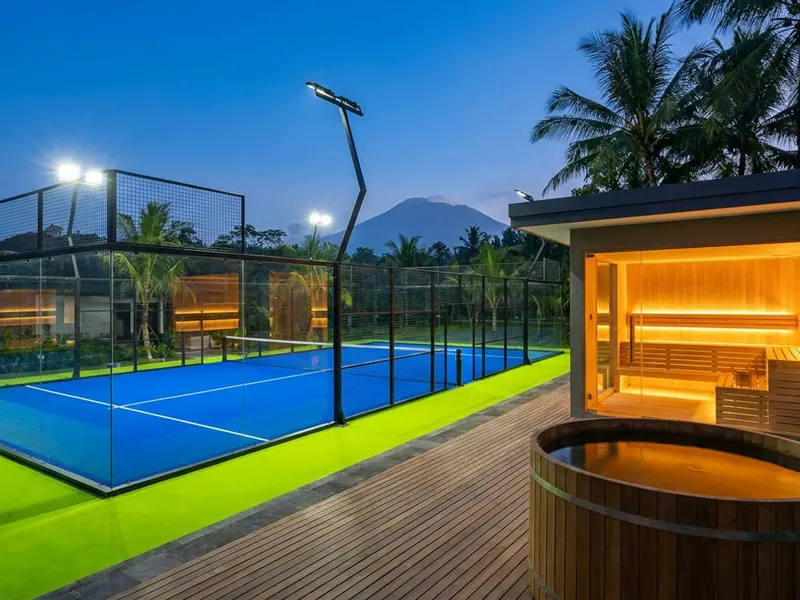
Lighting: glare-free LED on posts outside the structure, at least 300 lux across the playing area (FIP recommends 300–500 lux), with dimming for evening use.
Sound is the issue neighbours notice first — the crack of a ball on glass carries. We mount the glass with bolts and rubber gaskets that absorb impact vibration, use vibration-isolating fixings on the frame, add planting or perimeter screens as a buffer, and place the glass ends away from neighbouring bedrooms where the plot allows.
Materials That Last in Medan's Humidity
Medan's humidity is hard on steel, especially toward the Belawan coast. We specify hot-dip galvanised steel for the whole frame, 10–12 mm tempered safety glass (12 mm recommended), and monofilament synthetic turf with silica sand infill for consistent bounce. Underneath, the slab is compacted, laid over gravel and drainage pipes and finished with a 0.5–1% fall so water clears from the surface in about 10 minutes after rain stops. Written warranty terms for structure, glass and turf are set out in the contract.
Permits and Tax for a Sports Court on Private Land
A padel court is a permanent structure with foundations, power, lighting and glass walls, so it generally falls under building-permit rules. In Indonesia that means PBG (Persetujuan Bangunan Gedung, the successor to the IMB); for sites within the city it is processed through the Medan city administration. Adding a permanent improvement to your land can also have property and construction tax implications.
Requirements differ between Medan city, Deli Serdang and Binjai, and estate managements may have their own rules. We prepare the technical documents — drawings, structural calculations, electrical specification — but permit and tax specifics should always be confirmed with a licensed local professional. How PBG and SLF fit into the build schedule is explained in the padel court build timeline.
How Long a Private Court Takes to Build
Plan 10–14 weeks from survey to lights-on. The critical path is the same as for a club court: 3–4 weeks of concrete curing, and imported tempered glass with a 4–8 week lead time that must be ordered during design. An open outdoor court with glass in stock and firm ground can be ready in about 8 weeks. Medan's October–January rains add 2–3 weeks to earthworks and slab drying. The stage-by-stage schedule is in how long it takes to build a padel court.
Optional: Mini Sauna and Cold Plunge
Some owners pair the court with a small recovery corner: a compact sauna and a cold plunge next to the changing area. We plan the power, water and drainage for it together with the court so nothing has to be broken open later. It is priced as a separate line in the budget.
Private Padel Court Checklist
| Item | Requirement (estimate) |
|---|---|
| Land | 10 × 20 m playing area; about 12 × 22 m of level, usable land |
| Orientation | North–South preferred to avoid sun glare |
| Clear height (covered court) | 6 m minimum, 7–8 m recommended |
| Electrical supply | Dedicated circuit for LED lighting (typically 3-phase) |
| Drainage | Gravel base, underground pipes, 0.5–1% slab fall, perimeter channel |
| Permits | PBG building approval; confirm tax with a professional |
| Timeline | 10–14 weeks; about 8 weeks possible for an open court with glass in stock |
| Budget | From about Rp 700 million (standard outdoor); panoramic about Rp 1.06 billion; covered about Rp 1.28 billion |
Disclaimer: all figures, timelines, permit and tax details above are estimates for general guidance. They vary by location and project; the final budget and schedule follow a site survey. Please confirm permit and tax questions with a licensed professional.
FAQ
How much land do I need for a private padel court at home?
The playing area is a fixed 10 × 20 m. With run-off, access and light posts, plan about 12 × 22 m (≈264 m²) of level, usable land per court. With less than that, a full FIP court is usually not practical; we check on site whether the layout can be adjusted.
How much does a private padel court cost?
Estimate Rp 700 million – 1.1 billion for a standard outdoor court (our per-court RAB range; the ROI calculator uses about Rp 850 million). Panoramic glass with pro LED is about Rp 1.06 billion and a covered court with roof structure about Rp 1.28 billion. These are estimates; the final RAB follows a site survey.
Is a private court cheaper than a club court?
Per court, not necessarily: a club spreads earthworks, roofing and labour across several courts. A private build is cheaper overall because it needs no lobby, recovery zone or café. For comparison, a 4-court club with a recovery zone and café is estimated at Rp 3.1–5.2 billion.
Will a padel court at my Medan home disturb the neighbours?
Ball impact on tempered glass can be loud. We reduce it with rubber gaskets at the glass mountings, vibration-isolating fixings, planting or perimeter screens as a buffer, and by placing the glass ends away from neighbouring bedrooms where the plot allows.
Do I need a permit to build a sports court on private land in Medan?
A permanent structure with foundations, lighting and glass walls generally requires PBG building approval, processed through the Medan city administration for sites within the city. There may also be tax considerations. These vary by area, so always consult a licensed professional before you build.
How long does it take to build a private padel court in Medan?
Plan 10–14 weeks from survey to lights-on. An open outdoor court with glass in stock and firm ground can be ready in about 8 weeks. Medan's October–January rains add 2–3 weeks to earthworks and slab drying.
Plan a private court for your home or villa
Send the plot size, photos, location and the option you are considering (open, covered or panoramic). We reply with feasibility, an estimate per component and a survey date — anywhere in Medan, Deli Serdang or Binjai.
Chat on WhatsApp